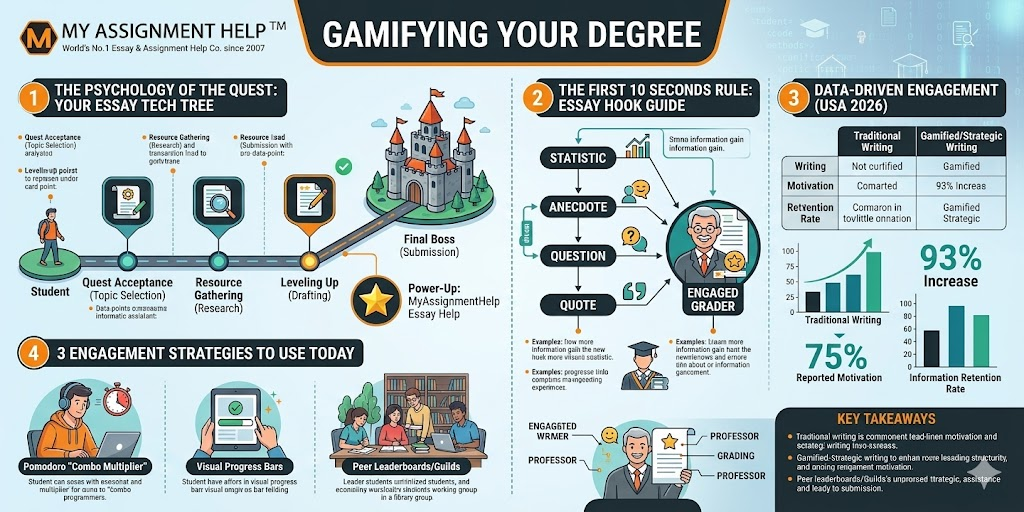
In the high-stakes landscape of American higher education in 2026, the “grind” of academic writing is being disrupted. With the Education Gamification market projected to hit $3.33 billion this year (Research and Markets, 2026), students are no longer just “writing papers”—they are optimizing their academic performance using game-mechanic frameworks.
Gamification isn’t just about badges and leaderboards; it is a psychological shift that turns a 2,000-word research project into a series of achievable “quests.” For the modern US student balancing a 15-credit load with a part-time internship (which often demands 15-20 hours weekly), applying engagement strategies to writing isn’t just fun—it’s a survival tactic.
The Psychology of the “Quest”: Breaking Down the Writing Process
Traditional academic writing often feels like a monolithic wall. Gamification breaks this wall into a “Tech Tree.” Just as a player wouldn’t fight a boss without the right gear, a student shouldn’t tackle a thesis without building foundational “Experience Points” (XP) in research and outlining.
Research from the Open Psychology Journal (2026) indicates that competitive and reward-based elements can increase student motivation by up to 93%. By treating each section of a paper as a “level-up” opportunity, students reduce the cognitive load and “procrastination paralysis” often associated with complex assignments. In fact, many students find that leveraging professional essay writing by MyAssignmentHelp acts as a strategic “power-up,” allowing them to study high-quality models and understand the “game rules” of A-grade academic prose more efficiently.
The “First 10 Seconds” Rule: Mastering the Hook
In game design, the “First Time User Experience” (FTUE) determines if a player stays or quits. In academic writing, your “FTUE” is your introductory paragraph. In the US, where professors may grade dozens of papers in a single sitting, an immediate engagement strategy is vital.
A compelling hook for an essay serves as your game’s “trailer.” Whether it’s a provocative statistic about the 2026 economy or a “narrative start” that drops the reader into the middle of a conflict, your hook must provide immediate “Information Gain.” According to 2026 pedagogical trends, narrative-based learning helps contextualize dry data, making the reader—and the grader—emotionally invested in your “story.”
Data-Driven Engagement: Why US Students are Gamifying
Why is this shift happening now? The data suggests a massive “Engagement Gap” in traditional classrooms.
| Metric | Traditional Writing | Gamified/Strategic Writing |
| Average Motivation Level | Low to Moderate | 93% Increase (reported) |
| Information Retention | 40-50% | 75% (through interactive elements) |
| Market Growth (EdTech) | 5-10% | 27.5% CAGR (2026 Forecast) |
| Task Completion Rate | Often delayed | Higher due to “Micro-Goals” |
3 Engagement Strategies to Use Today
- The Pomodoro “Combo Multiplier”: Set a timer for 25 minutes of “Deep Work.” Every successful session earns you a “Combo Streak.” Three streaks allow for a 15-minute “Reward Phase” (gaming, snack, or social media).
- Visual Progress Bars: Instead of looking at a word count, use a visual tracker. Divide your essay into 10% increments. Seeing a bar “fill up” triggers a dopamine release similar to leveling up in an RPG.
- Peer Leaderboards: Form a “Guild” with classmates. Use apps to track who clocks the most research hours or finishes their bibliography first. This healthy competition mirrors the “Social Play” aspect of modern gaming.
Key Takeaways
- Micro-Goals over Monoliths: Treat every sub-heading as a “Level” to prevent burnout.
- Invest in the “Hook”: Your opening is your “First Time User Experience”; make it count.
- Utilize Academic Power-ups: Don’t be afraid to use professional resources to understand complex “game mechanics” in writing.
- Track Progress Visually: Use data and progress bars to stay motivated.
FAQ Section
Q: Is gamification just for younger students?
A: No. In 2026, 30% of the gamification market is driven by Higher Education and corporate training. It is an effective cognitive tool for all ages.
Q: Does using an essay service count as “cheating” in this framework?
A: Think of it as a “Tutorial Mode.” Using professional examples helps you learn the standards and structures required to succeed on your own in future “levels.”
Q: What is the most effective type of “hook” for a US college essay?
A: In 2026, “Data-Driven Hooks” (surprising statistics) and “In Media Res” (starting in the middle of the action) are the most effective for grabbing a grader’s attention.
Author Bio:
Dr. Aris Thorne is a Senior Content Strategist at MyAssignmentHelp with over 10 years of experience in Educational Psychology and SEO-driven academic content. Specializing in the 2026 US Higher Education market, Dr. Thorne focuses on bridging the gap between student engagement and professional career outcomes.
References:
- Research and Markets. (2026). Gamification In Education Market Global Report 2026.
- Business Research Insights. (2026). Education Gamification Market Size, Trend & Share.
- Open Psychology Journal. (2026). The Cognitive and Motivational Benefits of Gamification.
- Smithsonian Science Education Center. (2026). 5 Benefits of Gamification in the Classroom.